

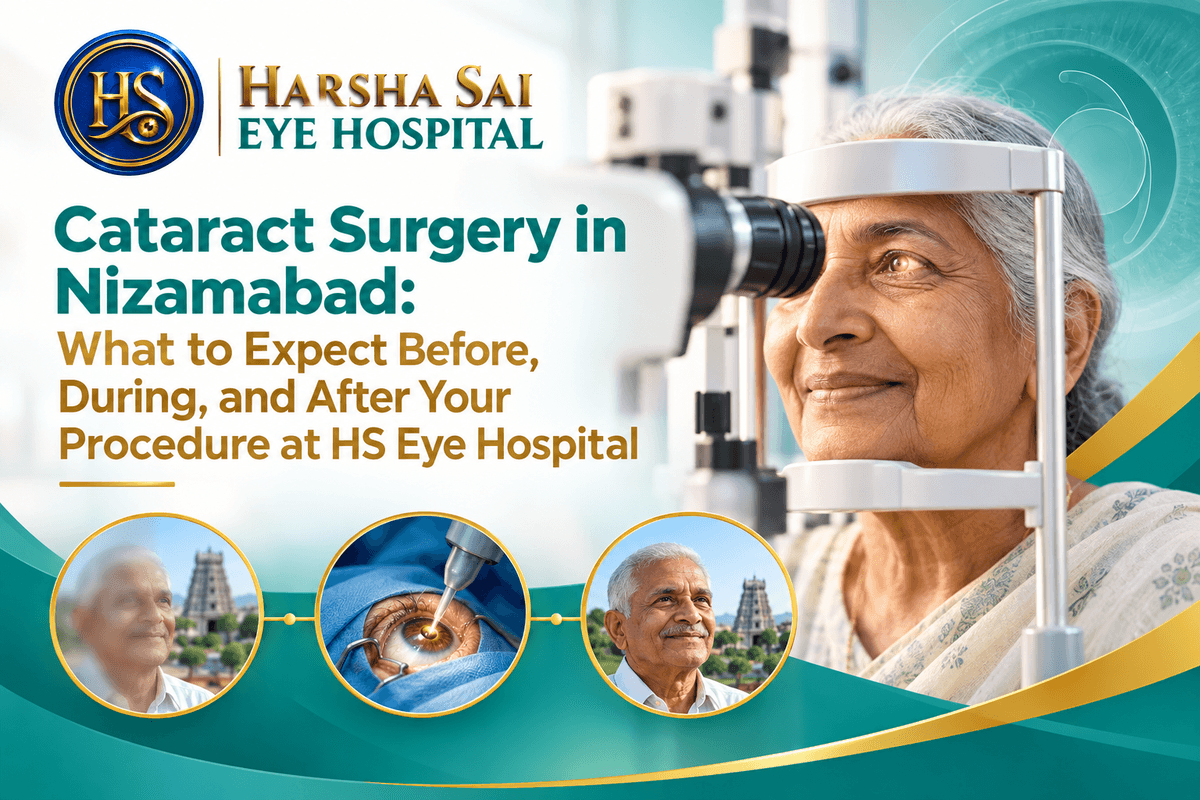
Cataract Surgery in Nizamabad: What to Expect Before, During, and After Your Procedure at HS Eye Hospital
When Your World Starts Going Blurry — You're Not Alone
You squint at the morning newspaper and the words won't sharpen. The headlights of evening traffic seem surrounded by halos. Colours that once looked vivid now appear washed out, as though someone draped a thin, grey curtain over your eyes. You might be quick to blame fatigue or old age — but what you could be experiencing is a cataract.
For millions of people across Telangana, including countless residents of Nizamabad district, this slow, painless clouding of the eye's natural lens is quietly stealing independence, confidence, and quality of life. Cataract is the leading cause of blindness in older adults, and among those aged 60 and above, it is the single most significant cause of visual impairment. Yet, despite being completely treatable, many people in our region delay care — often because they don't know what to expect from cataract surgery or where to go close to home.
If you or a loved one in Nizamabad is struggling with cloudy vision, this guide is for you.
The Direct Answer: Cataract Surgery Is Safe, Quick, and Highly Effective
Let's cut through the fear and uncertainty right away.
According to data published by the All India Ophthalmological Society (AIOS), the cataract surgery success rate in India ranges between 98% and 99%, depending on the type of surgery and the patient's health condition. Each year, over 6 million cataract surgeries are performed in India — making it one of the largest cataract programmes in the world.
The modern procedure of choice is phacoemulsification, commonly called "phaco." Phaco surgery is a minimally invasive procedure that uses ultrasonic energy to break up and remove the eye's cloudy natural lens, which is then replaced with a clear artificial intraocular lens (IOL). The procedure typically takes 15 to 30 minutes, is performed through a very small incision without stitches in most cases, and is usually completed as a same-day surgery.
Doctors perform it under local anaesthesia, so you remain awake but do not feel pain. Most people recover within 4 to 6 weeks, but vision often improves within a few days — as early as 24 to 48 hours after surgery.
There is no reason for patients in Nizamabad to travel to Hyderabad or beyond for world-class cataract care. Advanced eye surgery is now available right here in your city.
How HS Eye Hospital Guides You Through Every Step
At HS Eye Hospital, Nizamabad, the cataract journey is designed to be clear, compassionate, and completely stress-free — from the very first consultation to your final follow-up visit.
Before Your Surgery
Your care begins with a thorough pre-operative evaluation. Pre-operative testing, including biometry and health assessments, ensures your IOL is correctly powered and that you are fit for surgery. The team at HS Eye Hospital will review your complete medical history, including any existing conditions like diabetes or hypertension that may need to be managed around your procedure. You will also be counselled on which type of intraocular lens — monofocal, multifocal, or toric — best suits your lifestyle and vision goals.
Phacoemulsification offers patients the opportunity to choose from various types of IOLs, including monofocal, multifocal, and toric lenses, depending on their vision needs and lifestyle. Our ophthalmologists take time to explain each option in your language so that you leave the consultation feeling informed and confident, not overwhelmed.
During Your Surgery
On the day of your procedure at HS Eye Hospital, you will be made comfortable in our clean, sterile surgical suite. Most patients do not describe cataract surgery as painful because numbing medication is used. You may notice pressure, light, or movement, but you should not feel the surgical steps. The surgeon makes a small incision in the eye, typically less than 3 millimetres in size, and a specialised ultrasound device is then used to break up the cloudy lens into tiny fragments, which are gently suctioned out. A clear artificial lens is then placed precisely in position. Most operations take less than 20 minutes, and patients are usually back home the same day — no large cuts, no stitches, no overnight stays.
After Your Surgery
Post-operative care at HS Eye Hospital is structured and thorough. Strict post-operative care, including prescribed eye drops, activity restrictions, and follow-up appointments, is essential for optimal healing and vision outcomes. Follow-up exams are typically scheduled at 1 week, 3 weeks, and 6 to 8 weeks following surgery, and you will be advised to wear an eye cover while sleeping for 1 to 2 weeks. Our team in Nizamabad provides clear, written instructions in Telugu so that nothing is lost in translation.
Why the Evidence Supports Acting Now
Delaying cataract surgery is not a neutral choice — it carries real risk. Untreated cataracts worsen progressively, and advanced cataracts are technically more complex to operate on. Research covering over 52,000 adults in India found an overall cataract prevalence of 14.85%, with cataract surgery coverage at 76.95% — meaning nearly 1 in 4 patients who need surgery have not yet received it.
Across Telangana, the picture is similar. Studies from the region confirm that cataract accounts for 40.2% of all visual impairment, and it is the leading cause of blindness — a preventable tragedy given how safe and effective modern surgery is.
Research shows that it is possible to achieve excellent visual outcomes even in non-metro settings, with a best-corrected visual acuity of 6/12 or better noted in 91% of patients. Thanks to improved infrastructure and government-backed initiatives like the National Programme for Control of Blindness (NPCB), the rate of post-surgery complications has dropped to less than 1%.
At HS Eye Hospital, our experienced ophthalmologists, sterile operating environment, and modern phacoemulsification technology ensure that patients from Nizamabad and the surrounding areas — including Bodhan, Armoor, Kamareddy, and Nizamabad Rural — receive outcomes that match any top-tier eye hospital in Telangana.
Frequently Asked Questions About Cataract Surgery in Nizamabad
1. Is cataract surgery painful?
No. Due to local anaesthesia and modern techniques, most patients experience minimal discomfort. Numbing eye drops are applied before the procedure, and most patients report feeling only mild pressure or awareness of light — not pain. Any minor grittiness or watering after surgery typically resolves within a day or two.
2. How long does recovery take after cataract surgery?
Most people recover within 4 to 6 weeks, but vision often improves within a few days — you may notice clearer vision as early as 24 to 48 hours after surgery, though complete healing of eye tissues takes about one month. Most patients in Nizamabad are able to return to routine activities like reading and watching television within a week, though heavy lifting and strenuous work should be avoided during the healing period.
3. Can cataracts come back after surgery?
Cataract surgery results are permanent. However, some patients develop posterior capsule opacification — sometimes called a "secondary cataract" — months or years later, which is easily treated with a simple, painless laser procedure. Once the natural lens is removed and the artificial IOL is implanted, a true cataract cannot grow back.
4. What types of lenses (IOLs) are available at HS Eye Hospital in Nizamabad?
At HS Eye Hospital, patients can choose from a range of intraocular lenses based on their visual needs and budget. After cataract removal, an intraocular lens (IOL) is implanted to restore vision, with the main options being monofocal lenses, which improve vision at a specific distance — near, intermediate, or far. Multifocal and toric lenses are also available for patients who want to reduce dependence on glasses or correct astigmatism. Our ophthalmologists will recommend the best option based on your eye measurements and lifestyle.
5. How do I know if I need cataract surgery now, or if I can wait?
Cataract surgery is rarely an emergency. Most patients have weeks to months to plan the surgery, choose a surgeon, and decide on a lens. The exceptions are rare cases like lens-induced glaucoma or a hypermature cataract causing eye inflammation, where a doctor will recommend moving faster. If your blurred vision, night glare, or difficulty with daily tasks like driving or reading is significantly affecting your quality of life, it is the right time to visit HS Eye Hospital in Nizamabad for a comprehensive eye evaluation. Early intervention almost always leads to better outcomes.
Visit Us
Visit HS Eye Hospital for trusted, compassionate care. We're here for you and your family.
HS Eye Hospital
Nizamabad
Phone: +91 9640506574
Website: hseyehospital.com
Google Maps: https://www.google.com/maps/place/?q=place_id:ChIJZVsa6C7bzTsRgkMrrVXgUbk
Email: harshasaieyehospital@gmail.com